
There will come a time when your progress slows or stops, even if you’ve been perfect with your nutrition/workout plan.

This can be extremely frustrating especially if you’ve been working so hard to lose fat.
You might want to slash your calories, increase your cardio, or just give up in frustration.

I don’t recommend doing any of that.
Instead, I’m going to walk you through 5 steps you can take in order to overcome a weight loss plateau.
But first, you need to know this:
The scale is not and should not be your only measure of progress!
The scale measures your total body mass which includes fat, muscle, water, etc. It doesn’t tell you how much fat you’ve lost or muscle you’ve gained.
Your scale weight will fluctuate for many reasons that aren’t due to fat gain. I go over many of the reasons in this post. Most of it comes down to water fluctuations.
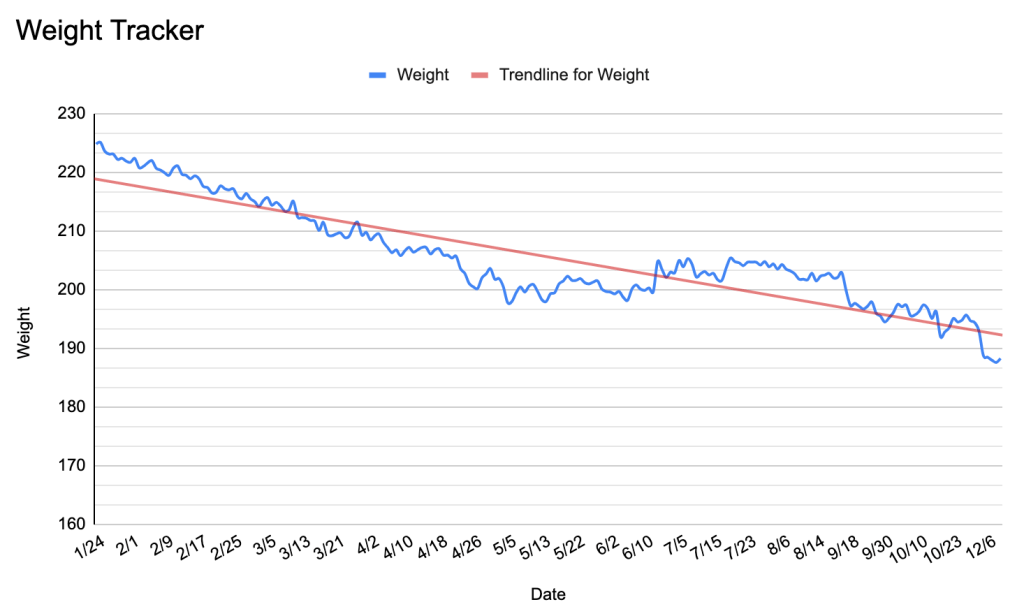
As you do daily weigh-ins, you are gathering data. You aren’t comparing your weight day to day to determine if your plan is working. Look at the average weekly weight month to month. If your plan is working, it will be a gradual downward trend with many spikes, dips, and plateaus along the way.
This is an example from one of my online fitness clients:
All of this to say, you need to be sure you are tracking progress in multiple ways, NOT just the scale.
I have my online fat loss clients track the following:
- Daily weigh-ins. First thing in the morning after you’ve used the restroom, before you eat or drink anything, and without clothes.
- Measurements. Every 2 weeks. Measure your waist, upper thigh, and hip circumference.
- Photos. Every month. Take a front, back, and side shot in good lighting against a blank wall.
We also track weights used in workouts and take note of “non-scale” wins each week. Things like, feeling more energized, sleeping better, clothes are fitting better, improved relationship with food, etc.
“When performance is measured, performance improves. When performance is measured and reported back, the rate of improvement accelerates.”
By tracking progress in multiple forms, you are gathering a lot more data to know if what you’re doing in working or not.
What is a weight loss plateau?
Before I get into the steps, let’s quickly define what a weight loss plateau is.
A weight loss plateau is when your weight stops changing.
This eventually happens to everyone who is trying to lose weight, even when you’ve been consistent with your nutrition and workout plan.
This can be very frustrating because obviously you are happier when you’re making progress! When you’re working hard for something and aren’t seeing results, you may feel defeated.
Following these 5 steps will give you hope and a game plan if you feel like you are in a weight loss plateau. Let’s get into it!
Step 1: Determine if you are actually in a weight loss plateau
The phrase, “I’m in a plateau!” can be thrown around haphazardly and might be somewhat overused.
While plateaus are normal and occur at some point during weight loss, the fact is for a lot of people, they actually aren’t in a plateau.
You just aren’t being patient enough.
Here are some questions to ask yourself to help determine if you are in fact, in a weight loss plateau:
- In the last 4 weeks, have my measurements gone down?
If yes, then what your doing is working. Keep going. Be patient.
- In the last 4 weeks, have my progress pictures looked any different?
If yes, then what your doing is working. Keep going. Be patient. Don’t quit!
- In the last 4 weeks, has the scale moved down?
If yes, then what your doing is working. Keep going. Be patient. Don’t quit! This is progress. You aren’t going to see the scale go down every day or even every week.
If you haven’t seen ANY changes to your measurements, photos, or weight in the past 4 weeks, move to step 2.
Step 2: Check Your Consistency
Before you make any changes to your program, you need to ask yourself another question:
- In the last 4 weeks, have I been at least 85% consistent with my plan?
If no, then you are not in a plateau. You need to figure out how to adhere to your program better. You need to be consistent with your program to know if it’s working well or not.
85% consistency means that in the last 30 day month, you’ve hit your nutrition and workout targets perfectly for at least 26 days with only 3-4 days off track.
If you haven’t been at least 85% consistent, start here and work on improving this. The more consistent you are, the faster progress you’ll have.
If you HAVE been at least 85% consistent, move to step 3.
Step 3: Check Your Accuracy
Have you been tracking your nutrition and workouts accurately?
Let’s start with nutrition. You need to make sure that you’re tracking calories accurately.
I’m going to review some common calorie counting mistakes that will help you determine if you are tracking calories correctly.
Common Calorie Counting Mistake #1:
You aren’t tracking the licks and bites throughout the day.
Maybe its the handful of crackers or chips you have while you’re cooking dinner.
Or maybe it’s the 2 or 3 bites off your kids plate at lunch.
Maybe it’s the 2 or 3 pieces of candy you have as you walk by the candy jar multiple times a day.
It might not seem like a lot of calories at the moment, but they add up and at the end of the day could very well move you out of a calorie deficit and into maintenance or even a surplus.
Common Calorie Counting Mistake #2:
You’re guessing portion sizes. You aren’t using a food scale to weigh your food. Or maybe you’re using measuring cups and spoons to measure portion sizes. In this video, I talk about why this isn’t the best method. You’re going to end up eating more calories than you realize if you’re using measuring cups or eye balling portion sizes.
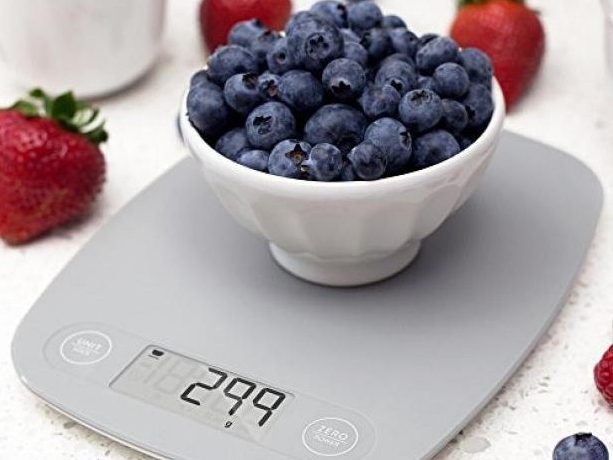
Weighing your food is going to be the most accurate way to track your calories. I know it’s annoying at first, but remember, this isn’t something you’ll need to do forever. It’s just a for a period of time.
Common Calorie Counting Mistake #3:
You aren’t tracking liquid calories from alcohol, soda, or juice.
I don’t think I need to explain much here, just know that these calories do add up and should not be left unaccounted for.

Common Calorie Counting Mistake #4:
You aren’t tracking the cooking oils or butter. This one is super common.
You’re tracking the calories of the chicken you’re cooking, but overlook the amount of calories from the oil you used to cook the chicken with.
Again, at the end of the day, these calories add up.
Common Calorie Counting Mistake #5:
You aren’t tracking weekends.
You’re on point Monday-Thursday and let loose every Friday-Sunday.
I get it, this is hard. You worked hard all week and want to relax a bit on the weekend.
However, Friday-Sunday make up 40% of your week. You need to stay on track these days in order to meet your weekly calorie goal.
My 2 biggest pieces of advice for the weekend is to plan ahead and if you know that you typically like to consume more calories on the weekend, play around with calorie cycling.
Calorie cycling will allow you to have more calories allocated for the weekend but you still meet your weekly calorie target. For example, if your weekly calorie goal is 14,000 calories, you can set it up like this:
Monday-Thursday: 1,850 calories
Friday-Sunday: 2,200 calories
At the end of the week, you’re meeting your weekly calorie budget of 14,000.
You also want to make sure you’re tracking your workouts correctly.
Are you moving your body as much as you think? Are you progressing in your workouts and pushing yourself appropriately?
If you feel like you aren’t tracking your nutrition and workouts accurately, start here and make improvements.
If you have been, move to step 4.
Step 4: You Have Three Options
Option 1: Drop your calories 100-200 while keeping you protein intake high
Be sure you continue to hit your protein goal which should be 0.7-1 gram of protein per pound of goal bodyweight.
If your calories are already super low, this is not the best option. Here are some signs that your calories are too low:
- your performance and strength in the gym is decreasing each week
- your sleep is terrible
- low sex drive
- high stress levels
- you’re irritable and moody
Option 2: Increase your daily activity by increasing steps or adding in 10-15 minutes of cardio at the end of your strength workouts
Aim to get 8-12k steps per day. This can help increase your energy expenditure to create a larger calorie deficit.
You don’t need to add hours and hours of cardio to your weekly workout routine in order for it to be effective.
Choose a cardio option that you enjoy. For some, it might be HIIT. For others, LISS.
If you go the HIIT route, aim for 1-2 hours a week max.
If you got the LISS route, 2-3 hours a week is plenty.
Option 3: Take a 7 day diet break and move into maintenance calories.
Dieting is a stress on your body. It’s also a stress mentally.
This is a good option if you feel like you’re constantly thinking and stressing about food. Taking a week off can give your mind and body a break away and help reduce cortisol, which can decrease water weight. (one of the things that can cause the scale to spike)
You might see the scale drop down simply because you are less stressed out from the diet.
Taking a quick break can also have an affect on your adherence to your plan when you jump back into it. You might feel more refreshed and rejuvenated to get back to your nutrition plan.
Step 5: Take a Full Diet Break
If you’ve gotten through the first 4 steps, you’ve likely been dieting for several months.
The best thing you can do for yourself mentally & physically is to take a 4-8 week break & move into maintenance calories.
This is a great option if your calories are already low and you’re doing a lot of cardio and are not seeing results. You can reverse diet (strategy of increasing your calories to improve body composition) to bring your calories up to maintenance.
This can help increase your daily total energy expenditure which will help elevate your metabolism.
You can do this by gradually increasing your calories each week. Anywhere from 50-150 calories per week to your current calorie intake until you reach your maintenance calories is a great way to reverse diet.
During this time, continue to do your workouts. Focus on getting strong and building muscle. Keep eating your protein!
Enjoy life and enjoy a nice break from dieting!
Final Thoughts
The last questions I want you to ask yourself are:
- What’s your goal bodyweight and why?
- Do you care more about the number on the scale or are you wanting to look a certain way?
Sometimes you just have a number in your mind that you want to weight. Maybe it’s what you weighed in college or high school or before you had babies.
Don’t get so caught up on a certain number on the scale that it causes you to lose focus of your goal.
You might look and feel your best at a higher number on the scale! Be okay with making adjustments to your goal bodyweight.
I hope this helps and as always, let me know if you have any questions!
Also, if you aren’t sure of what your calories should be in order to lose fat, click here to get my free calorie calculator!
-Christy
 CHRISTY EWING FITNESS